

When a Basketball Foul Becomes a Dog Whistle

Sometimes a foul is just a foul.
Two professional athletes are moving at full speed. One goes to the basket. The other tries to stop her. There is hard contact. The referees review the play, decide it crossed the line, assess a flagrant foul, and eject the player.
Normally, that is sports. But apparently, when the player committing the foul is Black, the player receiving it is white, and the white player has recently become popular in conservative political circles, we are no longer allowed to simply watch basketball.
Now it is politics.
And that brings us to the dog whistle.
What Is a Dog Whistle?
The term isn't something invented by political pundits to describe statements they don't like.
Merriam-Webster defines the political meaning of a dog whistle as an expression or statement with a secondary meaning intended to be understood by a particular group of people. In other words, the genius of a dog whistle is that two audiences can hear two different messages at the same time.
To the general public, the speaker can say: "I was just talking about a basketball foul."
But another audience hears something else entirely.
Look what they're doing to this white woman.
Look at the angry Black woman.
Look at how conservatives are treated.
And because none of those things necessarily have to be said explicitly, the person holding the whistle maintains plausible deniability.
That's the whole point.
Enter Michelle Ball and the WNBA
Recently, Michelle Ball decided that a foul in a WNBA game was apparently important enough to bring into our local political conversation.
The play involved Chicago Sky guard DiJonai Carrington and Indiana Fever guard Sophie Cunningham.
Carrington hit Cunningham high while Cunningham was attempting a layup. Officials reviewed the play, upgraded it to a Flagrant 2, and ejected Carrington.
Let's establish something immediately: It was a bad foul.
You don't have to pretend otherwise.
The officials were justified in reviewing it. They were justified in calling it flagrant. They were justified in ejecting Carrington. Even Indiana Fever coach Stephanie White said the Flagrant 2 ruling was appropriate, although she said she did not believe Carrington intentionally hit Cunningham in the neck.
So this isn't a defense of DiJonai Carrington's foul.
It's a question about why a basketball foul suddenly became political content. Basketball players commit hard fouls all the time.
What made this one interesting to the political right?
You Don't Have to Say the Quiet Part
This is where dog whistles become useful.
A politician doesn't have to write: "Look at this Black woman attacking a white conservative woman."
That would be too obvious.
You simply post the video.
Your audience supplies the rest.
And as expected, folks definitely did!
More than 300 comments followed Ball's post. Many stopped bothering with the whistle altogether.
They moved into overt racial commentary.
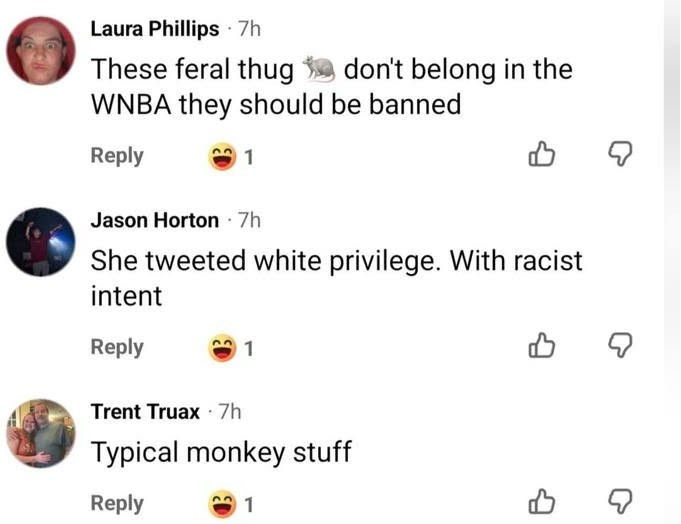


Words like “thug” and “ghetto” can function as racial dog whistles because they invoke stereotypes historically associated with Black people without explicitly mentioning race. That ambiguity provides convenient cover: the speaker can communicate a racialized message to people who recognize the implication, while denying any racist intent when challenged.
Other commenters are comfortable using "monkey" or the n-word. No hidden meaning there.
That matters.
Because at some point, "I had no idea people would interpret it that way" stops being a convincing explanation.
Political figures know their audiences. They know which subjects excite them. They know which stories generate outrage. They know which cultural flashpoints will produce hundreds of comments instead of twelve.
And they know that putting a Black WNBA player and a white player who has recently become a conservative-media celebrity into the same 15-second video is not politically neutral.
I cannot prove what was inside Michelle Ball's head when she hit "post." Neither can anyone else.
But we can evaluate political communication by something more useful than mind-reading: context, selection, audience, and predictable reaction.
Why this foul?
Why this player?
Why this moment?
Why is a WNBA foul relevant to local politics in Monroe, North Carolina?
Those questions matter.
But Isn't Carrington Political?
Yes.
And this is where we should be more honest than the people we're criticizing.
DiJonai Carrington has been politically outspoken. She has advocated for racial justice, gender equity, LGBTQ rights, and other progressive causes.
So if someone says Carrington has progressive politics, that isn't invented.
But notice the sleight of hand.
What do her political opinions have to do with whether she committed a basketball foul?
Nothing.
A referee does not ask for your voter registration before determining whether you made excessive contact.
The transformation goes like this: Black player commits foul against white player.
Becomes: Liberal “tolerant” Black player commits foul against conservative white player.
Which becomes: Liberal Black woman attacks conservative white woman.
And suddenly a routine piece of sports misconduct has been converted into another battle in America's endless culture war.
That transformation is the story.
And Is Sophie Cunningham a Conservative?
That's a little more complicated.
Cunningham recently generated national attention after saying transgender women should not compete in women's sports. Her comments were enthusiastically embraced by conservative political figures, including Vice President JD Vance and White House Press Secretary Karoline Leavitt.
That has helped turn Cunningham into something of a conservative cultural figure whether she intended to become one or not.
But Cunningham herself says her politics are "very much in the middle." She has rejected accusations that she hates transgender people and has said she would prefer the media to get back to talking about basketball.
She has not, however, withdrawn her underlying position about transgender athletes.
So calling her an outspoken conservative activist probably goes too far.
Calling her a player whose comments have recently made her extremely popular in conservative political circles is accurate.
And that distinction matters.
Here's Where the Story Gets Really Interesting
Sophie Cunningham knows something about Flagrant 2 fouls.
Because she committed one herself.
In June 2025, Connecticut Sun player Jacy Sheldon poked Cunningham's teammate Caitlin Clark in the eye during a contentious game. Later, Cunningham delivered a hard foul on Sheldon.
Cunningham was assessed a Flagrant 2 and ejected.
And this wasn't merely speculation about her intentions.
Cunningham later talked openly about deciding to do it, describing the moment as an impulsive decision to retaliate. Fox News reported the incident as Cunningham defending Clark and becoming the Fever's "enforcer." Her popularity exploded afterward.
Think about that contrast.
When Cunningham delivered a retaliatory Flagrant 2 foul, the story was:
Tough teammate protects Caitlin Clark.
When Carrington delivered a Flagrant 2 foul against Cunningham, suddenly the story became entangled with race, politics, "wokeness," and conservative victimhood.
Same league.
Same penalty.
Same Sophie Cunningham.
Very different cultural framing.
That doesn't mean every story about either foul is racist. It does mean we should ask why identical basketball terminology can produce such dramatically different narratives depending upon who is doing the fouling and who is getting fouled. And why Michelle is finally interested in women's basketball.
Fox News Apparently Loves WNBA Basketball Now
Perhaps the most amusing part of all of this is the sudden intense interest in women's professional basketball among people and media outlets that historically haven't exactly organized their lives around WNBA box scores.
Fox News has repeatedly covered Cunningham's altercations and the physical treatment of Caitlin Clark.
But its previous coverage of Cunningham's own Flagrant 2 is revealing.
Fox described Cunningham as receiving "praise" for having Clark's back. Another story discussed her "enforcer role." Another highlighted an NFL player's declaration that Cunningham had become his favorite player because she protected her teammate.
Apparently, a violent looking WNBA foul can mean very different things depending on who delivers it.
Sometimes it demonstrates toughness and loyalty.
Sometimes it becomes evidence of something much darker happening in America.
Funny how that works.
Carrington Didn't Help Herself
There's another part of this story that shouldn't be ignored.
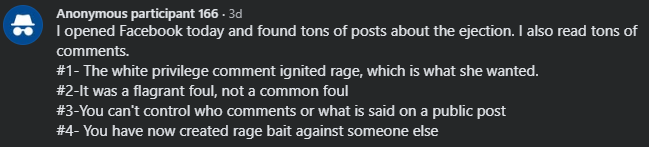
After Carrington's ejection, she posted the words "WHITE PRIVILEGE" on social media and tagged the Indiana Fever.
Watching Michelle Ball use this one foul as a political flash point, intent on riling up her specific brand of voter, is evidence that Carrington may be on point with the racism playing a role in the aftermath.
The foul deserved the Flagrant 2 designation. Cunningham herself pointed out afterward that she had previously been ejected for a similar foul and said race had nothing to do with what happened between her and Carrington.
Reporting on the incident also indicates that Cunningham said there was no personal animosity between the two before the game.
Carrington's post definitely poured gasoline onto a fire that was already burning, but it then became a prophecy about what would follow.
But here's the important distinction:
Two things can simultaneously be true.
Carrington committed a bad foul.
Carrington made an inflammatory racial comment afterward.
And conservative political actors can exploit the incident to activate racial resentment among their audiences.
None of those statements cancels out the others.
The Audience Tells You What It Heard
This brings us back to dog whistles.
One defense of this kind of political post is always:
"She never said anything racist."

Maybe not.
But dog whistles aren't designed to say the thing explicitly.
That's why they're dog whistles.
The more revealing question is: What did the audience hear?
When hundreds of comments beneath an otherwise ordinary basketball clip quickly turn into racial attacks, stereotypes, grievances about Black people, complaints about "DEI," attacks on the political left, and declarations about white people being persecuted, perhaps we should stop pretending everyone gathered there because they're passionate students of WNBA officiating.
They heard something.
And Robert Burns', Michelle's biggest advisor, has been doing exactly this kind of thing long enough to understand how it's going to go.
You throw the meat into the cage and then act surprised when the animals show up for dinner.
Plausible Deniability Is a Feature, Not a Bug
The beauty of a dog whistle is that the defense is built into the offense.
"I never mentioned race."
Exactly.
"I only posted a video."
Exactly.
"I can't control what other people comment."
Also true.
But imagine standing outside every evening ringing a dinner bell and then insisting you have absolutely no idea why everyone keeps showing up carrying plates.
Eventually, the explanation becomes ridiculous.
To the point that one commenter, on a post with a screenshot of someone using the n-word, actually said that it was ridiculous to call the comments racist.

That's a special kind of stupid right there.
Political communication isn't only about the literal words someone types.
It's about what they choose to amplify.
Out of thousands of news stories, why this one?
Out of countless sports highlights, why this one?
Out of all the problems facing Monroe, Union County, North Carolina, and the United States, why does a foul between two WNBA players require the attention of a local political figure?
Maybe Michelle Ball has suddenly developed an intense passion for women's professional basketball.
If so, fantastic.
I look forward to her analysis of pick-and-roll defense.
But if her WNBA commentary mysteriously appears primarily when a Black player does something that can be packaged as an attack on a white conservative cultural figure, we should probably recognize what we're actually watching.
It isn't sports commentary.
It's political signaling. And the folks being signaled heard it loud and clear.
Sometimes the Whistle Gets So Loud Everyone Can Hear It
The most disturbing part of this episode isn't even the original post.
It's what happened underneath it.
A dog whistle only works because the person blowing it doesn't have to finish the sentence.
Other people will happily do that for them.
The politician provides the image.
The audience provides the racial hierarchy.
The politician provides the outrage.
The audience provides the slurs.
The politician provides the plausible deniability.
And when someone finally points out what is happening, everyone suddenly becomes very literal:
"Show me where she said anything racist."
The question is why this particular message was chosen, who was expected to hear it, what they predictably heard, and what happened after they did.
A Black basketball player committed a flagrant foul against a white basketball player.
She was penalized.
She was ejected.
The game continued.
That should have been the story.
Turning it into evidence of some larger political struggle between Black and white, left and right, woke and conservative requires somebody to add another layer of meaning.
And once hundreds of people respond to that signal by saying the quiet part out loud, pretending nobody heard the whistle becomes increasingly difficult.
At some point, you have to consider another possibility.
Maybe the whistle worked exactly as it was intended. Reference Post Here.
![My Response to [Pompous]Pomegranate352](https://static.wixstatic.com/media/133499_26e58f96b366419e8b39a1da6ea9de48~mv2.jpg/v1/fill/w_980,h_980,al_c,q_85,usm_0.66_1.00_0.01,enc_avif,quality_auto/133499_26e58f96b366419e8b39a1da6ea9de48~mv2.jpg)


Comments