

What Makes a Mayor Great?


"Aye! The city
is all of that and more: it is the Voice of Democracy!”
Monroe’s mayoral election in November, delayed a year by state legislation that transferred the
vote to even-numbered years and made it partisan, pits Mayor Pro Tem Surluta Anthony against
former Mayor Pro Tem David Dotson. Anthony would become the majority-minority city’s first
elected Black mayor, although former council member P.E. Bazemore was once appointed
briefly to the role. She would be the second woman mayor, after Judy Long Davis, who served
three terms before 2005. Mayor Robert Burns did not seek re-election and has announced a race
for governor in 2028. Incomplete records show Monroe has had at least 48 mayors since it was
created in 1844.
The most consequential Monroe leader who served as mayor was J. Ray Shute (1904-1988), who
was elected to two two-year terms starting in 1947. Voters in Monroe’s Precinct 2 will cast their
ballots in a center named for him. His political career followed an unusual trajectory. After one
term in the state senate (1935, helped create the statewide library system), one term as chairman
of the school board (established Western Union High School for Black students), and three terms
as chairman of the board of county commissioners (brought Camp Sutton to Monroe). As mayor,
he led the city’s acquisition of the Camp Sutton land that helped achieve his vision of balanced
industrial and agricultural economy in Union County.
“The city is crowded streets and quiet park lanes; the hurry of people going to and from work;

His civic involvement included heading the Chamber of Commerce, the Monroe Board of Trade,
the Monroe Board of Realtors, the Monroe Lion’s Club, the Union County Chapter of the
American Red Cross, the Board of Trustees of Union Memorial Hospital, the Monroe Executive
Club, and the Duke Alumni Association.
In business, he founded WMAP Radio in 1946 and exercised leadership he J.R. Shute Company,
Shute Motors, Inc., United Airways of North Carolina, Monroe Investment, Inc., Union Aircraft
Corp., Union Broadcasting Station, Union Laundry Service, Shute-Wilson Gin Company, Ellen
Fitzgerald Hospital, Finance Corporation of America, Background Sound Systems, Inc., the
Southern Regional Council, the Monroe Full Fashion Hosiery Mill, and the Union County
Industrial Development Commission.
He was an amateur anthropologist and traveled with his wife Sarah to some 125 countries, living
with indigenous people in Outer Mongolia, the Amazon jungle, and elsewhere. He was a
delegate to the International Humanist Association in Amsterdam in 1952 and to the International
Association for Religious Freedom at Oxford University in England. He was also a leader in
local, state, national, and international organizations.
In religion, after years as a top-level leader of Central Methodist Church, he became a Unitarian
in 1948, started a chapel in his home compound on Windsor Street near Five Points, and rose to
national prominence in the denomination, where he was friends with poet Carl Sandburg. The
change came while he was mayor, and he won re-election. Then he wrote a book, His Honor the
Heretic. He also favored beer and wine sales in a 1949 Monroe referendum, after the county had
outlawed the beverages 4,197-812. Monroe voted down beer 1,088-733 and wine 1,15-700, but
Shute later won re-election.


He was a passionate advocate for civil rights, cofounding the Union County Council on Human
Relations in 1956 with NAACP President Robert Williams. He spoke and published widely in
support of the Supreme Court’s Brown v. Board decision that overturned “separate but equal”
public education. In 1957, he posted a $7,500 bond for Dr. A.E. Perry, who was falsely accused
of performing an abortion.
Shute set a high standard for mayors: a comprehensive economic vision; a commitment to human
equality, racial justice, and religious freedom; a lifetime of civic service locally, statewide,
nationally, and internationally.
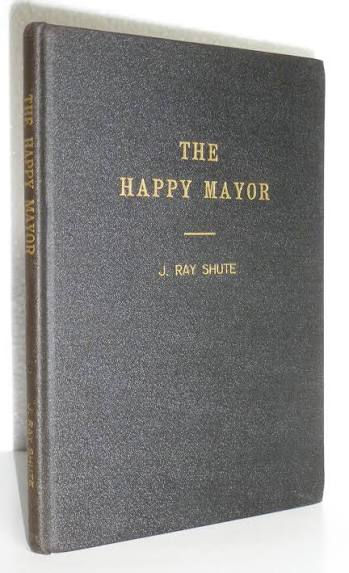
In 1951, he published The Happy Mayor, a collection of talks he had given. Its last chapter
explains why he valued the role so highly:
“The city is crowded streets and quiet park lanes; the hurry of people going to and from work;
the clean hospital beds and jammed baseball parks; the factory whistle and the peaceful ringing
of church bells; the throb of commerce and of children going to schools; rain-drenched rooftops
and sunny playgrounds; squalid slums and pleasant cottages; the blare of sirens and the quiet of
libraries; the village drunk and the welfare worker; the winding alleys and the broad greens; the
harlot in the hovel and the gold star mothers silently offering a community prayer. Aye! The city
is all of that and more: it is the Voice of Democracy!”
![My Response to [Pompous]Pomegranate352](https://static.wixstatic.com/media/133499_26e58f96b366419e8b39a1da6ea9de48~mv2.jpg/v1/fill/w_980,h_980,al_c,q_85,usm_0.66_1.00_0.01,enc_avif,quality_auto/133499_26e58f96b366419e8b39a1da6ea9de48~mv2.jpg)


Comments