

The Rise and Fall of Charlotte’s I-77 South Toll Lanes: A Timeline
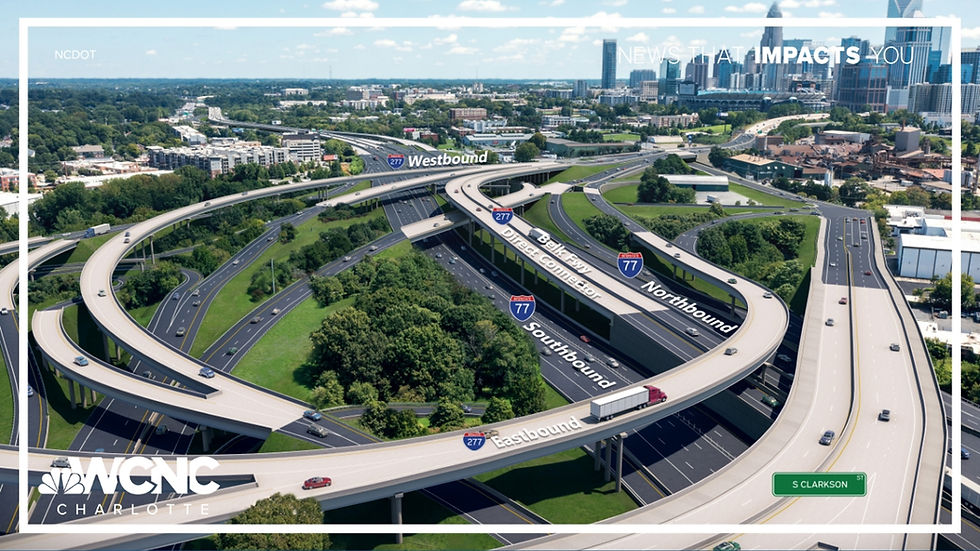
This will be a multi-part series that explores the CRTPO and the I-77 project that recently got voted down. The first part, starting here, will give a full timeline and description of events that led up to the final vote made by the CRTPO that ended this project.
The second part will be much more interesting as we explore the repercussions of that vote and the political gamesmanship of Mayor Robert Burns and State Senator Vickie Sawyer.
But for now, let’s explore what happened with the CRTPO and I-77 and why we’ve been hearing so much about it in the news these days…If you’ve driven on I-77 South through Charlotte recently, you already know the pain. The traffic is soul-crushing. The stop-and-go crawl from the state line to uptown is a daily ritual for thousands of commuters. And for nearly two decades, state and local leaders have promised a fix.
But this week, that fix, a massive $3.2 billion toll lane project, officially died. Or did it?
What followed was a classic North Carolina political drama: local councils voting late into the night, state senators threatening to pull funding, and a private developer waiting in the wings. It was a story of good intentions, broken trust, and a very expensive lesson in how regional transportation planning really works.
Here’s the unbiased, start-to-finish timeline of how the I-77 South project was proposed, who was going to build it, and how a series of votes, and one legislative power play, brought it all crashing down.
The Dream (2007–2014)
The idea wasn’t new. Back in 2007, the Charlotte region identified I-77 South as a prime candidate for “express lanes” in a regional study. The concept was simple: add new, dynamically-priced toll lanes alongside general-purpose lanes, giving drivers the option to pay for a faster trip.
For years, it remained just that, a concept. But in 2014, the Charlotte Regional Transportation Planning Organization (CRTPO), the local body that decides which road projects get the green light, took its first formal vote. They approved a regional project list that included widening I-77 South with these express lanes. It was the first local seal of approval.
At the time, it felt like a win. We were finally moving forward.
The Reality Check (2023–2024)
Then came the math.
By 2023, the North Carolina Department of Transportation (NCDOT) ran the numbers on a traditional, publicly-funded widening. The verdict? A staggering $1.3 billion funding gap. Simply put, the state didn’t have the cash to do this the old-fashioned way.
So NCDOT did what any agency would do when it’s short billions: they looked for a partner. In October 2024, CRTPO voted again. This time to officially advance the project as a Public-Private Partnership (P3). This was the critical pivot. Under a P3, a private company would design, build, finance, operate, and maintain the toll lanes. The state would own the asphalt, but the private partner would control the pricing, the construction timeline, and the maintenance for up to 50 years.
Sound familiar? It should. It’s the exact same model used for the I-77 North Express Lanes, built by the Spanish firm Cintra. And if you remember the outcry over that project, the skyrocketing tolls, the lawsuits, the public anger, you already know where this story was heading.
The Community Erupts (Late 2025)
By the fall of 2025, NCDOT held public meetings to show off the preliminary designs. And that’s when the honeymoon ended.
Residents along the I-77 South corridor were furious. The new designs showed the highway expanding closer to their homes, eating into front yards and back fences. The plans felt impersonal, heavy-handed, and tone-deaf. Trust in NCDOT, already frayed from the I-77 North debacle, plummeted.
Community groups organized. Local officials started getting an earful. The project that was supposed to solve traffic had become a symbol of bureaucratic overreach.
The Knife Turns (May 2026)
This is where the timeline gets dramatic.
May 11, 2026: The Charlotte City Council takes a stand. After hours of public testimony, they vote 6-5 to rescind their support for the project’s funding agreement. It was a razor-thin margin, but the message was clear: the city was pulling the plug.
May 20, 2026: The big one. The CRTPO—the very body that had approved the project twice before—convened for a do-or-die vote. And they followed the city’s lead, officially rescinding their support for the I-77 South toll lanes.
This was the kill shot. Under state law, NCDOT cannot force a toll lane project onto a region that doesn’t want it. The CRTPO’s vote gave local communities a direct veto, and they used it.
Within days, NCDOT announced it would remove the project from the State Transportation Improvement Plan. The $600 million in state funds that had been earmarked for I-77 South? Reallocated elsewhere. The private developer? Left at the altar.
Raleigh Strikes Back (June 2026)
But the story wasn’t over. If you thought Raleigh would take this lying down, you haven’t been paying attention to North Carolina politics.
Enter State Senator Vickie Sawyer. She immediately drafted legislation to force a reversal. Her proposed amendment was a scalpel and a hammer. It would have required any local government that voted to rescind support for the project to repay the $64 million that NCDOT had already spent on planning, design, and engineering.
And if they didn’t pay up? The state would withhold future road funding until the debt was settled.
Senator Sawyer didn’t mince words. She called it a "stick" and a "warning" to local governments who, in her view, were reneging on a deal.
The backlash was swift. An attorney for the town of Matthews called the proposal "unlawful," arguing it punished local leaders for simply listening to their constituents. Several smaller cities, fearing the financial hit, tried to reverse their own votes to avoid the penalty.
For a few weeks, it looked like Raleigh and Charlotte were headed for a full-blown constitutional showdown.
The Ceasefire (June 2026)
Then, cooler heads prevailed.
Senator Sawyer ultimately held off on adding the amendment to the final legislation. Her reasoning was pragmatic: the project was already scheduled to be formally removed from the state’s priority list by August, and keeping the amendment alive could jeopardize funding for other, unrelated road projects across the state.
She didn’t back down on principle, she backed down on strategy. The warning shot had been fired. The message to local governments was loud and clear: “Don’t do this again!”
The Aftermath: What Now?
So where does that leave us?
The I-77 South toll lanes are dead. For now. But the forces that created them, congestion, population growth, and a chronic lack of transportation funding, haven't gone away.
The project’s collapse also leaves a bitter aftertaste. The state spent $64 million on a plan that went nowhere. Local leaders feel vindicated for listening to their residents. And Raleigh legislators feel betrayed by local governments that changed their minds after years of collaboration.
The only certainty is this: the next time NCDOT proposes a Public-Private Partnership in the Charlotte region, the scars from this fight will be fresh. Communities will be more suspicious. Politicians will be more cautious. And the traffic on I-77 South will still be bumper-to-bumper.
The toll lanes may be gone, but the gridlock, and the debate, is here to stay.
![My Response to [Pompous]Pomegranate352](https://static.wixstatic.com/media/133499_26e58f96b366419e8b39a1da6ea9de48~mv2.jpg/v1/fill/w_980,h_980,al_c,q_85,usm_0.66_1.00_0.01,enc_avif,quality_auto/133499_26e58f96b366419e8b39a1da6ea9de48~mv2.jpg)


This is the information for all residents to consider before following their partisan beliefs. It seems that no one really wants to take the time and examine the details of current issues. I had no idea what the CRTPO was until last week. I attended the city council meeting on June 17 and Mark Watson, City Manager, gave an excellent synopsis of the background and details related the role of the City of Monroe in CRPTO and the I-77 toll lane project. This was not partisan politics until State Senator Sawyer made that introduction. It's so much easier to dig in your heels and stick your head in the sand and block out all the things you don't want to…