

The Battle of Athens and the Importance of Free Elections

Like many people, I occasionally stumble across interesting historical stories through social media. Recently, a TikTok series introduced me to a story about the Battle of Athens in Tennessee. Social media should never be anyone’s primary source of information, but it can serve as a starting point for further research. After digging deeper into the events surrounding the Battle of Athens, I found a story that was far more significant, and far more unsettling, than I initially expected.
What happened in McMinn County, Tennessee, during the 1930s and 1940s was not simply a political disagreement. It was a prolonged breakdown of democratic norms, public trust, and fair elections. It is also a reminder that free societies depend on citizens who are willing to defend transparency and accountability in government.

The Rise of Corruption in McMinn County
Paul Cantrell was elected sheriff of McMinn County in 1936 while campaigning against the abusive fee system used by law enforcement at the time. Sheriffs and deputies were allowed to personally keep many of the fees associated with arrests and other official actions, creating a system that encouraged unnecessary arrests for profit.
Despite campaigning against the practice, Cantrell ultimately embraced and expanded it. Over the course of a decade, his administration reportedly collected hundreds of thousands of dollars in fees, worth millions today when adjusted for inflation. Under Cantrell and later Sheriff Pat Mansfield, corruption became deeply embedded within county government.
The problems extended well beyond arrest fees. Cantrell’s political machine operated protection schemes involving gambling and prostitution while maintaining control through intimidation and election manipulation. Elections themselves became increasingly suspect. Ballot boxes were routinely removed from polling locations and taken to the county jail for counting, often without public oversight. Opposition poll watchers were denied access, and accusations of voter fraud became common.
Citizens increasingly believed that election outcomes were predetermined. Many simply stopped voting altogether, convinced their participation no longer mattered.
The political machine strengthened further when Cantrell ally George Woods was elected to the Tennessee legislature. Woods helped reduce the number of voting precincts in the county and cut the number of justices of the peace in half, consolidating power among Cantrell supporters. Efforts to introduce voting machines for more transparent elections were eventually undone through legislation that abolished the courts responsible for ordering them in the first place.
A County at War With Itself
In 1942, Cantrell moved to the Tennessee legislature and was succeeded as sheriff by Pat Mansfield, who continued operating the same system. Around the same time, the United States entered World War II, and thousands of young men from McMinn County left to serve overseas.
While many local residents were fighting abroad, corruption at home continued to grow. Mansfield, short on able bodied men thanks to the war, reportedly hired ex-convicts as deputies and expanded the culture of intimidation already present in the county.
Citizens repeatedly appealed to state and federal authorities for help. Complaints about election fraud, voter intimidation, and corruption were raised throughout the elections of 1940, 1942, and 1946. Those pleas largely went unanswered.
When veterans returned home after the war, many found conditions worse than when they had left. Returning servicemen, often carrying military savings, became targets for arrest and fee collection. The contrast between fighting for democracy overseas and witnessing corruption at home created deep frustration among many veterans.
The Formation of the GI Party
By 1946, dissatisfaction had reached a breaking point.
As Mansfield prepared to seek higher office and Cantrell looked to reclaim the sheriff’s position, a coalition of local veterans organized to challenge the political machine directly. Meeting privately, they formed what became known as the GI Party, a nonpartisan slate made up of both Democrats and Republicans united around a single goal: ending corruption in McMinn County.
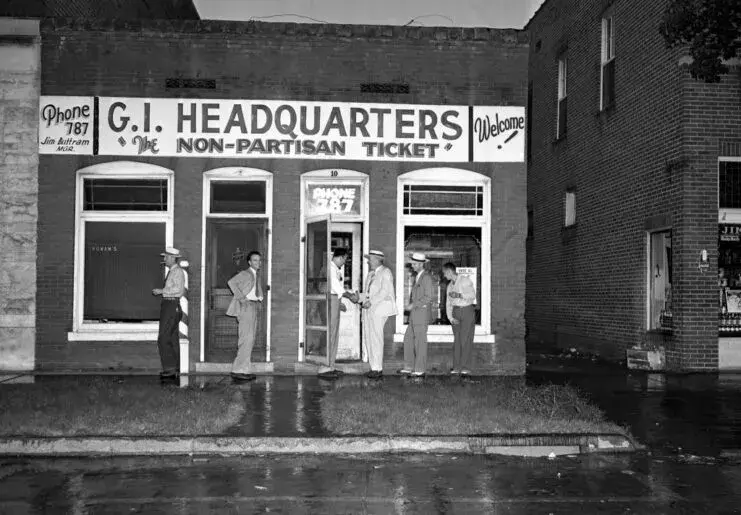
Their platform was remarkably simple. They wanted honest elections, transparent government, and an end to political intimidation.
Cantrell’s organization responded aggressively. Veterans attempting to register to vote often discovered the county’s only voter registration book was suddenly “missing.” Others had their poll tax receipts confiscated or were arrested on questionable charges.
Anticipating election interference, the GI Party organized a volunteer security force of roughly sixty veterans to monitor the polls. Cantrell responded by dramatically increasing the number of armed deputies stationed throughout the county. On Election Day in 1946, approximately 200 deputies were deployed, far above the number typically used during local elections.
Election Day Violence
On August 1, 1946, voters arrived at the polls in record numbers. Tensions escalated almost immediately.
Before voting officially began, a legally appointed election observer was arrested after protesting voting irregularities. Armed deputies controlled access to polling stations, allowing only small numbers of voters inside at a time. Poll watchers reported intimidation, physical assaults, and arrests throughout the day.
One of the most disturbing incidents involved sixty-year-old Black voter Tom Gillespie. When Gillespie attempted to vote, a deputy reportedly told him he would not be allowed to cast a ballot. After insisting on his constitutional right to vote, Gillespie was beaten and forced from the polling location. When he returned and refused to leave, the deputy shot him.
Other reports described open vote-buying and violent attacks on poll workers who challenged election practices. Despite the overwhelming turnout, it appeared increasingly likely that the election would once again be manipulated in Cantrell’s favor.
The Battle of Athens
As reports of violence and fraud spread, veterans regrouped in downtown Athens. Many were frustrated and demoralized, believing the election had already been stolen.
Bill White, one of the veteran leaders, argued that the people of McMinn County had already exhausted every peaceful avenue available to them. Complaints to authorities had gone unanswered for years. Elections had repeatedly been manipulated. Citizens had been threatened, beaten, and arrested for trying to participate in the democratic process.
Motivated by that belief, the veterans armed themselves, including by obtaining weapons from a nearby National Guard armory.
The confrontation centered around the county jail, where Cantrell’s deputies had taken the ballot boxes for counting. Veterans demanded that the ballots be counted publicly and transparently. When those demands were ignored, gunfire erupted.
Accounts differ on the exact sequence of events, but the standoff eventually turned into a full siege of the jail. At one point, an ambulance arrived and veterans briefly paused fire under the assumption it was evacuating wounded individuals. Instead, Cantrell and Mansfield reportedly used the ambulance as cover to escape.
The battle continued until the veterans used dynamite to disable vehicles surrounding the jail. Eventually, the deputies inside surrendered.

Remarkably, despite the intensity of the conflict, no deaths were reported during the battle itself.
Afterward, several ballot boxes believed to have been tampered with were discarded. The remaining ballots showed a decisive victory for the GI Party candidates.
The Aftermath
The Battle of Athens effectively ended the Cantrell political machine’s control over McMinn County. While some structural problems within local government remained, election practices improved and political intimidation diminished significantly.
The GI Party itself did not last long. Once reform candidates were elected, many eventually returned to their previous political affiliations. But the events of 1946 left behind an enduring lesson about the importance of transparent elections and public accountability.
The story also serves as a warning. When citizens lose faith that elections are fair, trust in democratic institutions begins to erode. Free societies rely not only on laws and constitutions, but also on public confidence that the political process remains open, honest, and accountable.

Eleanor Roosevelt once warned, “If a political machine does not allow the people free expression, then freedom-loving people lose their faith in the machinery under which their government functions.”
That warning feels just as relevant today as it did then.
Modern Reflection
One of the reasons I found the story of the Battle of Athens so compelling is because it highlights the importance of political independence and civic engagement. The GI Party was not built around rigid party loyalty. It was formed by people who believed their community deserved honest government and fair elections.
Too often, modern politics encourages voters to think only in terms of party affiliation. Democrats support Democratic candidates. Republicans support Republican candidates. In many places, voters are left choosing what they see as the lesser of two evils rather than the best possible leaders for their communities.
Local politics does not have to work that way.

Communities benefit most when candidates are judged by their integrity, competence, and willingness to serve rather than by party labels alone. Healthy local government depends on engaged citizens who are willing to ask difficult questions, demand transparency, and support leaders who genuinely prioritize the public good over personal ambition.
The Battle of Athens is ultimately not just a story about political corruption. It is a story about citizens refusing to surrender their voice.
Sources and Further Reading
The Fighting Bunch by Chris DeRose
![My Response to [Pompous]Pomegranate352](https://static.wixstatic.com/media/133499_26e58f96b366419e8b39a1da6ea9de48~mv2.jpg/v1/fill/w_980,h_980,al_c,q_85,usm_0.66_1.00_0.01,enc_avif,quality_auto/133499_26e58f96b366419e8b39a1da6ea9de48~mv2.jpg)


Comments